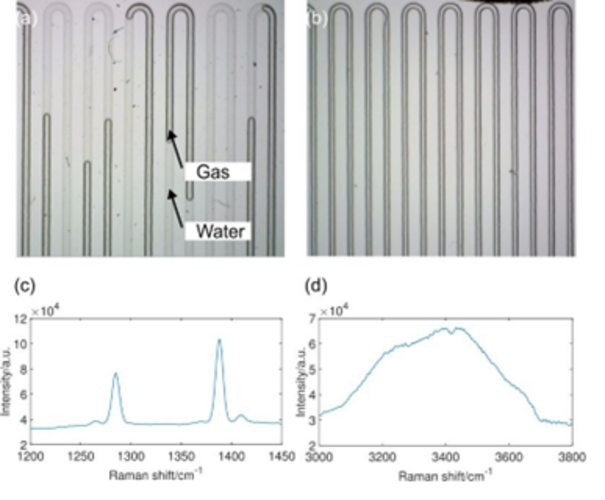
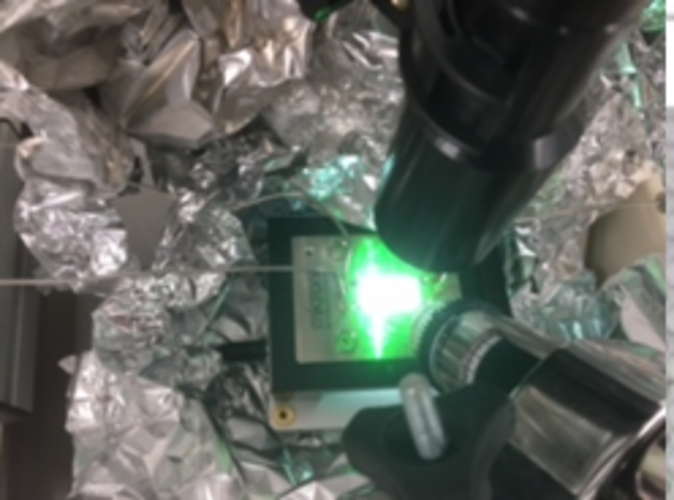
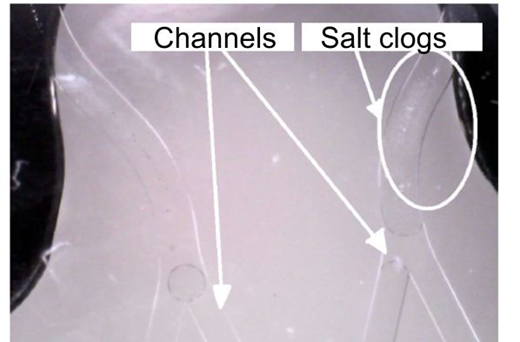
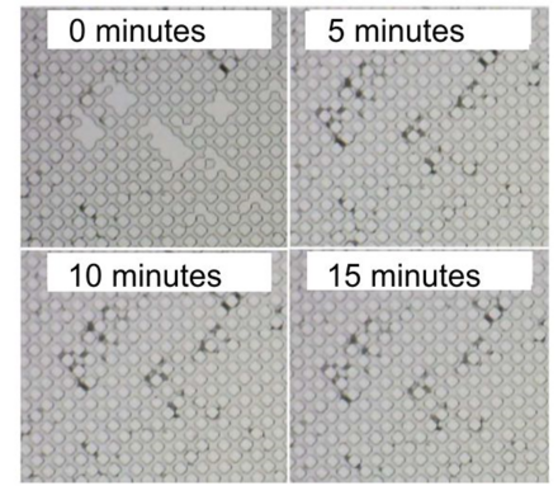
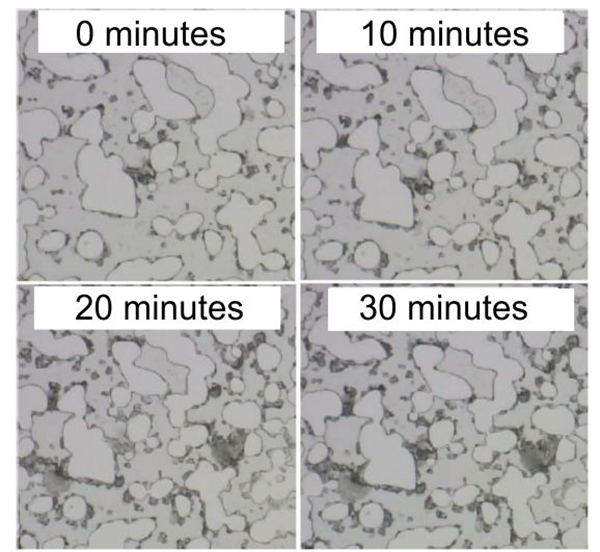
Physics, dynamics and governing mechanism was conducted. We focused on the extent, distribution, and precipitation pattern of salt crystals with an emphasis on the physics and dynamics of the phenomenon. In the last period, undertaken work was focused on:
a) nucleation and growth of isolated large single crystals and sub-micrometer-sized aggregates; b) self-enhancing nucleation and growth;
b) length (distance), velocity, and volume of brine transported by capillary suction and capillary-driven backflow;
c) continuity of water film and its transport mechanisms;
d) dissolved salt type, concentration, impurities, and supersaturation level;
e) pressure and temperature conditions on a broad range and for different phase states;
f) CO2 injection flow rate and concept of critical velocity;
g) impact of capillary forces versus viscous forces;
h) precipitation location, timing, and growth direction in inlet-outlet-bulk positions;
i) clogging mechanisms and affinity to become interconnected.
We hypothesize that salt precipitation is a dynamic process with the potential to severely influence single and two-phase permeability in the near-well environment. In particular, those crystals that precipitate within the CO2 phase are far more critical than what is previously assumed for local precipitation due to residual brine saturation in the porous medium. It is, therefore, in our opinion, a mistake to limit the precipitation phenomenon to high salinities storage sites.